The first time I really looked at a bourbon flavor wheel, my honest reaction was: I have no idea how this is supposed to help me. Half the things on the outer ring were flavors I’d never tasted or in some cases never even heard of. Stonefruit. What is stonefruit? I genuinely don’t know what that tastes like. And if you don’t know what a flavor tastes like, seeing it on a wheel doesn’t do you a bit of good. It took me a few tries to figure out what I was doing wrong — and once I did, the whole thing clicked into place.
What a Bourbon Flavor Wheel Actually Is
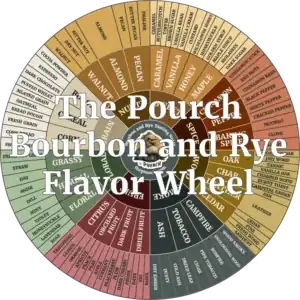
A flavor wheel is a visual reference tool that organizes the aromas and flavors found in bourbon and rye whiskey into categories, moving from broad to specific as you work from the center outward. The inner ring holds the primary flavor families — Sweet, Spice, Wood, Smoke, Fruit, Floral, Grain, Nutty. The middle ring breaks those down into subcategories. The outer ring gets specific — individual descriptors like butterscotch, cracked pepper, cedar, dark cherry.
The idea is to give you a vocabulary for what you’re tasting. Bourbon is complex, and most people — even experienced drinkers — know they’re picking up something in the glass but can’t quite put a name to it. The wheel gives you a starting point and a path to follow.
The key word there is starting point. And that’s where most people, myself included, get it wrong the first time.
Start in the Middle. Not the Outside.
My mistake the first few times I used a flavor wheel was starting on the outer ring. I’d nose a pour, then scan all those specific descriptors looking for a match. It was overwhelming and mostly useless. There are too many options out there, and without a framework to narrow things down first, you’re just guessing.
The lightbulb moment came when I was sitting in my home bar one evening — nosing kit out, bourbon poured, flavor wheel in front of me — and I just started in the middle instead. I asked myself the simplest possible question: what’s the dominant thing I’m picking up? Sweet dominated. So I started there and moved to the next ring. What kind of sweet? I was tasting something in that direction but it wasn’t quite caramel. I moved to the outer ring and landed on butterscotch. That was it. That was the note.
From there I kept going — back to the center, pick the next dominant note, work outward again. The wheel went from confusing to genuinely useful in about ten minutes. The whole thing is designed to be used inside-out, not outside-in. Once you get that, it makes sense.
Here’s the simple process:
How to Use a Bourbon Flavor Wheel
Step 1 — Nose first, wheel second. Take a slow gentle sniff before you look at anything. Let your brain register what it’s picking up without anchoring to a descriptor on the page. What you notice first is usually your strongest note.
Step 2 — Start at the center. Look at the primary categories in the inner ring. Which one is closest to what you’re getting? Sweet? Spice? Wood? Pick the one that fits best and move outward from there.
Step 3 — Move to the middle ring. Within your primary category, which subcategory fits? If you landed on Sweet, are you getting Caramel, Vanilla, Honey, or Maple? Narrow it down.
Step 4 — Check the outer ring. Now look at the specific descriptors in that subcategory. Does one of them match what’s in the glass? If yes, you’ve got your note. If not, go back to the middle ring and try a neighboring subcategory.
Step 5 — Repeat for secondary notes. Go back to the center and start again for the next thing you’re picking up. Most bourbons have three to five identifiable notes if you take the time to look for them.
The Problem With Most Flavor Wheels
No flavor wheel is going to help you if you don’t know what the flavors on it actually taste like. That sounds obvious, but it’s the thing that made most wheels frustrating for me early on. A lot of them are built by professional tasters with highly trained palates, and the outer ring descriptors reflect that — stonefruit, petrichor, lanolin, things that are technically accurate but meaningless to most people who didn’t grow up eating at Michelin-starred restaurants.
I’m a kid from the Tennessee Valley in Alabama. We have good food down there, but it’s not gourmet. It’s comfort food. And bourbon, at its heart, tastes like comfort food — caramel, vanilla, brown sugar, cinnamon, pecans, dried fruit, a little smoke. Those are flavors most people have actually tasted. Those are the flavors I built The Pourch wheel around.
The goal wasn’t to create the most technically comprehensive wheel on the market. It was to create one that actually works for the person sitting in their living room with a pour in hand trying to figure out what they’re tasting. Eight primary categories, logical subcategories, and over 100 descriptors that most people will recognize without needing a culinary dictionary.
The Pourch Bourbon & Rye Flavor Wheel — $4.99
Eight primary flavor categories, logical subcategories, and over 100 descriptors built around the flavors most people actually recognize. Instant PDF download, prints to 7 inches on standard letter paper. Designed to work for real people tasting real bourbon — not professional tasters in a controlled environment.
Shop The Pourch →The Pourch Bourbon Tasting Bundle — $9.99
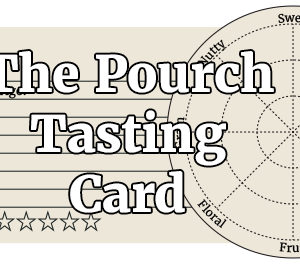
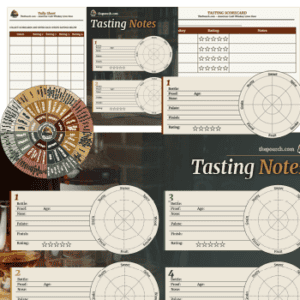
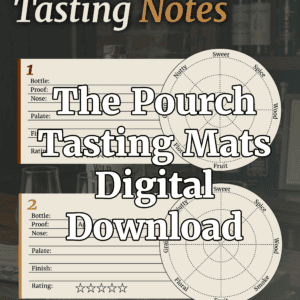
The flavor wheel plus tasting mats, scorecards, tally sheet, and tasting cards — everything you need to run a proper bourbon tasting. One download, print as many as you need, forever.
Shop The Pourch →How I Use It Now
Honestly, I don’t lean on it the way I used to. After enough time doing this you develop your own vocabulary and the notes come more naturally. But it still happens — you’re tasting something you can’t quite name, you know it’s there, you just can’t land on it. That’s when the wheel earns its keep.
I printed a copy of my own wheel and folded it up inside my tasting journal. It’s been sitting there as a bookmark ever since, marking the next empty page. When I get hung up on a note I can’t place, I unfold it, work my way from the center out, and usually find what I’m looking for in about thirty seconds. Then it goes back to being a bookmark. That’s about the right relationship to have with a flavor wheel once you’ve been at this a while.
A flavor wheel gives you the vocabulary. A nosing kit trains your nose to actually recognize what the words mean. If you’re serious about developing your palate, the two work well together. Our honest take on whether nosing kits are worth the investment is in Bourbon Nosing Kits: Do They Actually Work? →
If you’re hosting a tasting and want to put a flavor wheel at every seat alongside a proper tasting mat, we cover all the options in Bourbon Tasting Mats and Scorecards: The Accessories That Make It Feel Like an Event →
Ready to put all of this to work at an actual tasting? Everything you need to host one is in How to Host a Bourbon Tasting at Home: The Complete Guide →
The Pourch Verdict
A flavor wheel won’t do the tasting for you and it won’t fix a palate that isn’t paying attention. But if you start in the middle, work your way out, and stick to descriptors you actually recognize, it’ll change the way you experience a pour. Print one out. Fold it up and stick it in your journal. Use it when you need it. It earns its keep.
Affiliate Disclosure: Some links on this page are Amazon affiliate links. If you purchase through them, we earn a small commission at no extra cost to you. We only recommend gear we’d actually put on our own bar. We are never paid to recommend a specific product.