There’s a moment that happens to a lot of bourbon drinkers — usually somewhere around the time you start going deeper into the rabbit hole — where you realize everybody else seems to know something you don’t. You’re watching a video review, or you’re at a tasting with some friends who’ve been at this longer than you, and they’re talking about a particular bottle like they wrote the distillery’s biography. They’re rattling off flavor notes, comparing it to other expressions, remembering exactly what they thought the first time they tried it three years ago. And you’re standing there thinking — how do they know all that?

I had that moment. More than once, actually.
I love bourbon. I’ve loved it for years. But for a long time I was drinking it the way most people watch movies — just consuming it, enjoying the experience in the moment, and then letting it fade. I couldn’t tell you with any confidence what I’d tasted in a given bottle six months later. The details blurred together. Good bourbons got lost in the shuffle right alongside the forgettable ones. And I wanted to be more fluent in the language that serious enthusiasts were speaking.
So I started keeping a whiskey tasting journal.
Drinking With Intention Changes Everything
The first thing journaling did for me — and this happened almost immediately — was change the way I approached a pour.
When you know you’re going to write something down, you pay attention differently. You slow down. You nose the whiskey before you taste it. You actually think about what you’re tasting instead of just registering “yeah, that’s good.” You start asking yourself questions — what’s that note underneath the vanilla? Is that spice on the front or the back of the palate? How long does this finish actually last?
Drinking with intention is a different experience than just drinking. Not better in every situation — sometimes you just want to pour a glass and sit on the porch and not think too hard about it, and that’s perfectly fine. But when you taste intentionally, you start to actually develop your palate instead of just exercising it. There’s a difference.
The journal is what forces that intention. It’s a simple thing, but it works.
If you want to put that intention to work with a group, hosting a structured tasting is the best way to do it. We cover everything you need to pull one off in How to Host a Bourbon Tasting at Home: The Complete Guide →
Writing It Down Commits It to Memory
Here’s something I didn’t expect: the act of writing tasting notes helps you remember bourbon even when you’re not consulting the notes.
I don’t have a photographic memory. I’m 55 years old and I’ve tasted a lot of whiskey. But the bourbons I’ve journaled — even ones I tasted two or three years ago — I can recall with a level of detail that surprises me sometimes. Not every nuance, but the shape of the thing. Whether it was sweet-forward or spice-forward. Whether the finish was long or quick. What I thought of it overall.
The ones I didn’t journal? A lot of them are just gone. Good bottles I enjoyed in the moment and then lost completely.
Writing engages a different part of your brain than just tasting does. It forces you to put language to an experience that’s easy to leave vague, and that process of finding the words is what makes the memory stick. Teachers have known this about their students for decades. Turns out it works for bourbon drinkers too.
You’re Building a Reference You’ll Actually Use
After a while, your tasting journal stops being just a record and starts being a resource.
I flip back through mine fairly regularly — before I buy a bottle I’ve had before, before I revisit a distillery, when someone asks me what I think about a particular expression. It’s a personal reference library that no app or website can replicate, because it’s built entirely on my palate, my experience, and my honest reaction to what was in the glass on a specific night in a specific place.
That index in the front of the journal — where you log every entry by page and rating — turns out to be more useful than you’d think. When you’ve got 50 or 80 tastings documented, being able to flip to the index and find a specific bottle in ten seconds instead of reading through every entry is the kind of small thing that makes a tool feel like it was designed by someone who actually uses it.
The Context Is Half the Story
This is the thing I figured out after using a journal I’d bought on Amazon for a while — and it’s the reason I eventually ended up designing my own.
Most tasting journals give you structured fields for the standard stuff: nose, palate, finish, proof, age, rating. That’s all useful. But every journal I looked at was missing a full context page — a place to capture everything around the tasting that isn’t technically about the whiskey but absolutely affects how you experience it.
Who you were with. Where you were. What glassware you used. Whether there was a campfire nearby or a kitchen full of food aromas. Your mood and energy level going into the session. Whether you’d eaten something that was still coating your palate.
Look — sensory science will back me up on this. Your environment shapes what you perceive in the glass. A smoky outdoor setting can amplify smoky notes in a bourbon you wouldn’t have called smoky in a clean tasting room. Strong food aromas can mask subtle floral or fruity notes you’d otherwise catch on the nose. Even your emotional state affects how sensitive your palate is on a given night.
That context isn’t noise. It’s data. And when you’re reading back through an entry a year later, it’s also the part that makes it feel like a memory instead of a lab report.
I wanted that in a journal. I couldn’t find it. So I built it.

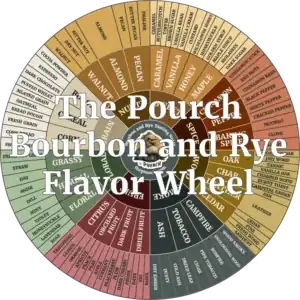
One tool that makes a real difference when you’re trying to put language to what’s in the glass: a good flavor wheel. The Pourch flavor wheel covers over 100 specific descriptors across eight flavor categories — keep it next to your journal and it’ll cut down on the time you spend staring at a blank notes page. How to Use a Bourbon Flavor Wheel →
You Don’t Have to Be an Expert to Start
I want to head off the thing that stops a lot of people before they ever pick up a pen: the idea that you need to know what you’re doing to take tasting notes worth keeping.
You don’t.
There’s no wrong way to describe what you taste. If vanilla is the first thing that comes to mind, write vanilla. If the closest thing you can get to a particular note is “smells like my grandmother’s kitchen at Thanksgiving,” write that — because years from now that note will mean more to you than any technical descriptor. The point of tasting notes isn’t to sound like a professional. It’s that you can read it back later and know exactly what you meant.
The journal is for you. Nobody’s grading it.
And here’s what I’ve found: the more you do it, the more your vocabulary grows naturally. You start noticing things you couldn’t name before. You start recognizing patterns — which distilleries make the kind of bourbon you gravitate toward, which mash bills tend to produce the flavor profile you love. It happens gradually and then all at once, and you realize one day that you’re the one at the tasting who seems to know what they’re talking about. That’s not an accident. That’s the journal doing its job.
Where to Start
You could start tonight with a legal pad and a pen and it would still be worth doing. The tool matters less than the habit. But if you’re going to build the habit, you might as well build it with something worth keeping.

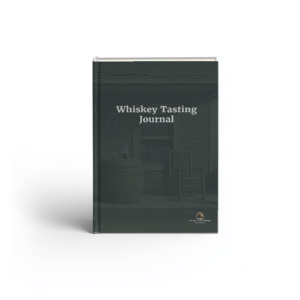
The Pourch Whiskey Tasting Journal — $19.99
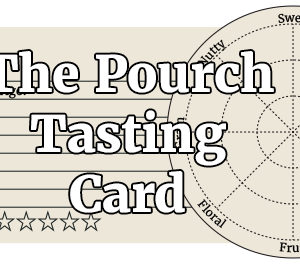
Hardcover, 50 full tasting entries, structured tasting form built for American whiskey, 12-spoke flavor radar chart, full context page for every entry, and a tasting index up front. The one I use. Print-on-demand and shipped to your door — allow about two weeks.
Shop The Pourch →The Pourch Premium Linen Tasting Journal — $29.99
Everything in the standard journal, with 100 entries instead of 50, premium linen wrap cover, gold foil spine, and a protective dust jacket. The one you put on the shelf and keep. For the serious sipper who’s in this for the long haul — or the person on your gift list who’s getting harder to shop for.
Shop The Pourch →The Pourch Verdict
You could start tonight with a legal pad and a pen and it would still be worth doing. The tool matters less than the habit. But if you’re going to build the habit, you might as well build it with something worth keeping. Pour something good. Write it down.
Affiliate Disclosure: Some links on this page are Amazon affiliate links. If you purchase through them, we earn a small commission at no extra cost to you. We only recommend gear we’d actually put on our own bar. We are never paid to recommend a specific product.